
The No REDD in Africa Network participated in a meeting held on 15th July 2025, with over 100 participants – civil society leaders, grassroots activists, and environmental justice advocates – from ten countries, including Burkina Faso, Ghana, Mali, Mozambique, Nigeria, Sierra Leone, Senegal, Togo, South Africa and the United States of America convened at the Shehu Musa Yar’Adua Centre in Abuja, Nigeria for a Roundtable of the West Africa Climate Justice Movement (WACMo). The roundtable focused on the escalating climate crisis facing the West African region and also brought together grassroots activists to proffer dialogue and profer solutions to the same.
The session was opened with a compelling keynote delivered by Dr. Nnimmo Bassey, HOMEF’s Executive Director, he urged for an urgent shift in language from “global warming” to “global heating and burning” to reflect the severity of the crisis. He emphasized that fossil fuel and coal companies, not humanity as a whole, are the main culprits. Dr. Bassey critiqued the failure of global climate agreements and condemned so-called “solutions” such as carbon trading, the blue economy, and other market-based mechanisms promoted by international financial institutions and the polluting transnational fossil companies. He warned of worsening forced migrations, referencing the displacement of coastal communities in Nigeria, Senegal, Togo and the tragedy of Mediterranean migrant drownings, situating climate change as a matter of human rights.
He went further to present concepts like “Ogonize” and “Yasunize,” which are drawn from African and Latin American resistance movements, as models of successful peaceful defiance against extractive industries.
The Roundtable challenged dominant narratives by framing climate justice as a movement rooted in fairness, historical accountability, and grassroots resistance. Global “green” frameworks, such as the Green Economy and Blue Economy, often perpetuate eco-colonialism by displacing communities and concentrating power in the hands of corporations. With examples from Togo cited, sustainability projects that benefit companies at the expense of local people were condemned. The West Africa Climate Justice Movement was admonished to avoid reproducing exploitative fossil fuel dynamics in the renewable energy transition.
Contributions from participants reinforced the urgent need for citizen science, legal action, coalition-building, and stronger recognition of indigenous and women’s knowledge systems. Speakers raised critical questions about who should be held accountable for climate debt and how to ensure community-led solutions are implemented.
Country representatives shared vivid accounts of their national struggles. In Mali, communities are resisting land grabs and building agroecological resilience. Burkina Faso is combating desertification and deforestation through reforestation and initiatives that empower women. Senegal is facing challenges related to coastal erosion and the development of controversial energy partnerships. Ghana faces internal displacement and the expansion of fossil fuel exploration projects, while Sierra Leone struggles with mining, flooding, and biodiversity loss. Togo contends with marine pollution, flooding from upstream dams, and threats from fossil fuel extraction. Nigeria’s crises are multidimensional, including oil spills, gas flaring, floods, and water as well as air pollution.
A strategic panel session explored how to build an intentional Pan-African response to these shared challenges emphasising the need to centre indigenous knowledge, promote gender equity, and connect ecological justice to cultural identity and ancestral wisdom. Legal and academic voices highlighted the importance of environmental education, policy reform, and resisting greenwashed “solutions” that displace communities.
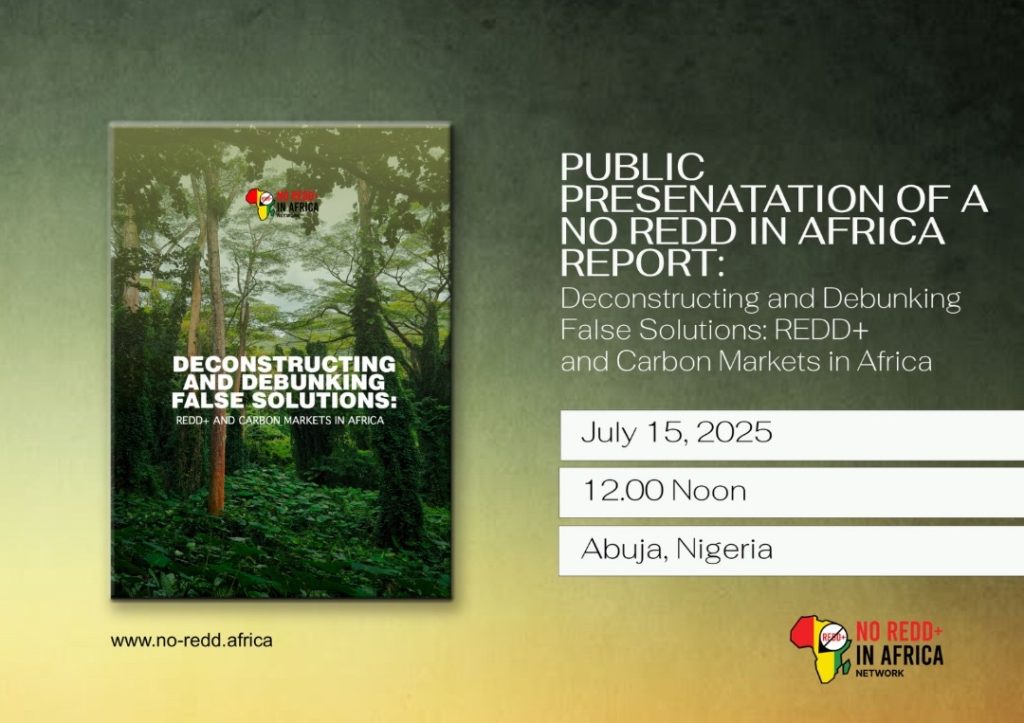
One of the highlights of the roundtable was the official launch of the report titled Deconstructing and Debunking False Solutions: REDD+ and Carbon Markets in Africa by the No REDD in Africa Network. The report which is based on a research study that was carried out poignantly exposes the spread of REDD and other REDD type projects on the continent. It also reveals with staggering statistics how carbon offset schemes commodify nature, undermine real climate action, and dispossess indigenous peoples of their land. The report is available in English, French and Portuguese versions and its available on the website.
The roundtable concluded with powerful resolutions including the rejection of carbon markets and expansion of fossil fuels extraction; strengthening of intergenerational knowledge transfer; intensification research to arrive solutions fitting local context in west Africa; and the use litigation as a core part of climate justice demands in the region.